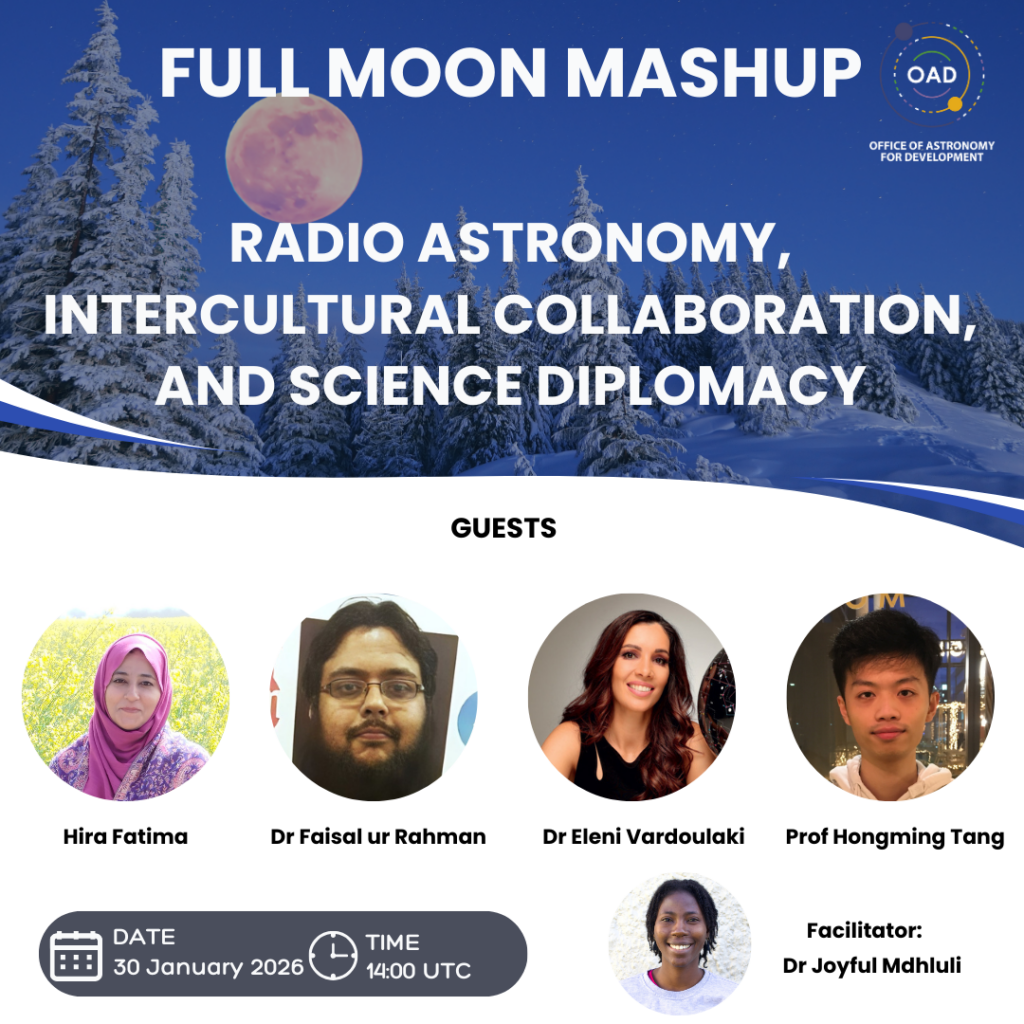
We are excited to kickstart the 2026 Full Moon Mashup series with a conversation that explores how astronomy can connect cultures, strengthen international collaboration, and contribute to science diplomacy.
How can astronomy bring people, cultures, and countries closer together?
The next Astro4Dev Full Moon Mashup will explore this question by focusing on the international and intercultural dimensions of astronomy-for-development projects, with a particular lens on radio astronomy as a bridge for collaboration and dialogue.
This session will be led by Dr Joyful Mdhluli and will feature project leaders Hira Fatima, Dr Faisal ur Rahman, Dr Eleni Vardoulaki and Prof Hongming Tang, from the Astro4Dev-supported initiative:
Radio Astronomy for Development: Intercultural Innovation and Outreach – A Modern Silk Road via Radio Astronomy Education.
Astronomy has long transcended borders, languages, and belief systems. In today’s interconnected world, it also plays an increasingly important role in building intercultural understanding, strengthening international partnerships, and supporting informal science diplomacy.
The featured project brings together educators, students, and institutions from different cultural and national contexts, using radio astronomy education as a shared platform for learning, curiosity, and collaboration. By engaging participants across continents, the project demonstrates how scientific cooperation can foster mutual respect, challenge stereotypes, and create meaningful connections beyond geography.
While rooted in education and outreach, projects like this one speak to something larger. They show how grassroots scientific collaboration can contribute to the broader goals of science diplomacy – building trust, sustaining dialogue, and nurturing long-term relationships between societies.
During this Full Moon Mashup, we will explore:
-
How intercultural astronomy projects are designed and implemented in practice
-
What project leaders have learned from working across cultures and contexts
-
How shared scientific experiences can support dialogue and understanding
-
What lessons astronomy-for-development offers for science diplomacy and international cooperation
The Astro4Dev Full Moon Mashup series creates a relaxed, conversational space for the global astronomy-for-development community to reflect, exchange ideas, and learn from lived experiences.
This session invites participants to engage with project leaders, ask questions, and think collectively about how astronomy can continue to serve as a tool for connection in a divided world.
Whether you are working in education, outreach, research, policy, or international development, this discussion offers valuable insights into how astronomy can connect cultures and contribute to global cooperation.
To catch up on our previous Full Moon Mashups, visit here.
Speakers bio

Dr. Syed Faisal ur Rahman is a cosmologist and radio astronomer focusing on large-scale structure, dark energy, and radio continuum surveys. He is a Resident Scientist at LUMS and holds memberships in the SKA Cosmology Working Group, as well as the EMU-ASKAP and WALLABY-ASKAP collaborations. His research focuses on clustering statistics, cross-correlations, and investigations of the CMB Cold Spot. Since 2013, he has been teaching Astronomy, Scientific Computing, and other STEM subjects, aiming to empower people with the critical thinking and technical skills needed to explore the universe, solve real-world problems, and sustain livelihoods. Apart from publishing his research in academic journals, Dr. Rahman is an active science communicator, contributing articles to newspapers and magazines to promote outreach and science for development. Bridging academia and industry, Dr. Rahman champions intercultural collaboration by leading cross-border technical teams spanning Pakistan, India, the United States, and the Gulf.
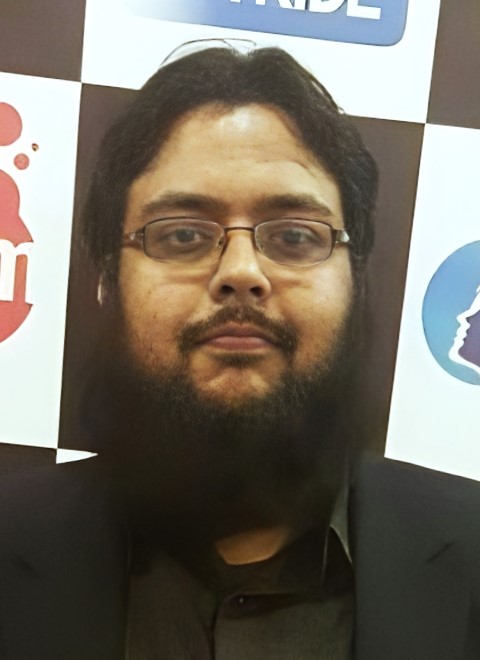
In this capacity, he applies AI-driven data systems and distributed technologies to solve large-scale collaboration challenges. He is also a contributor to the IAU-OAD RADIIO project’s Pakistan chapter as co-manager, utilizing radio astronomy as a platform for outreach, human resource development, intercultural exchange, and science diplomacy.
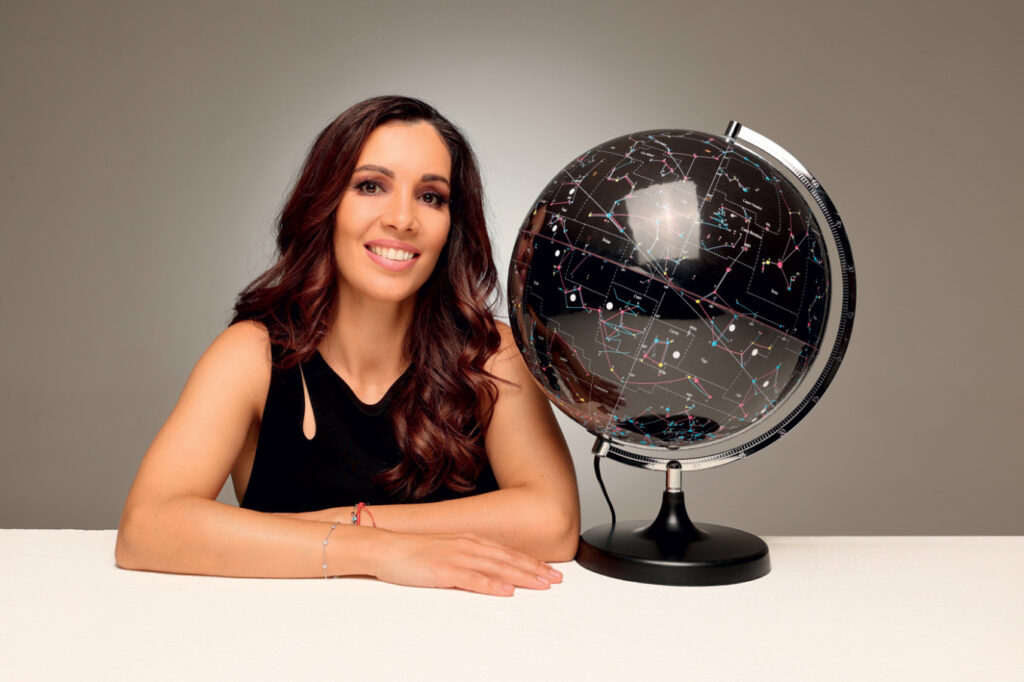
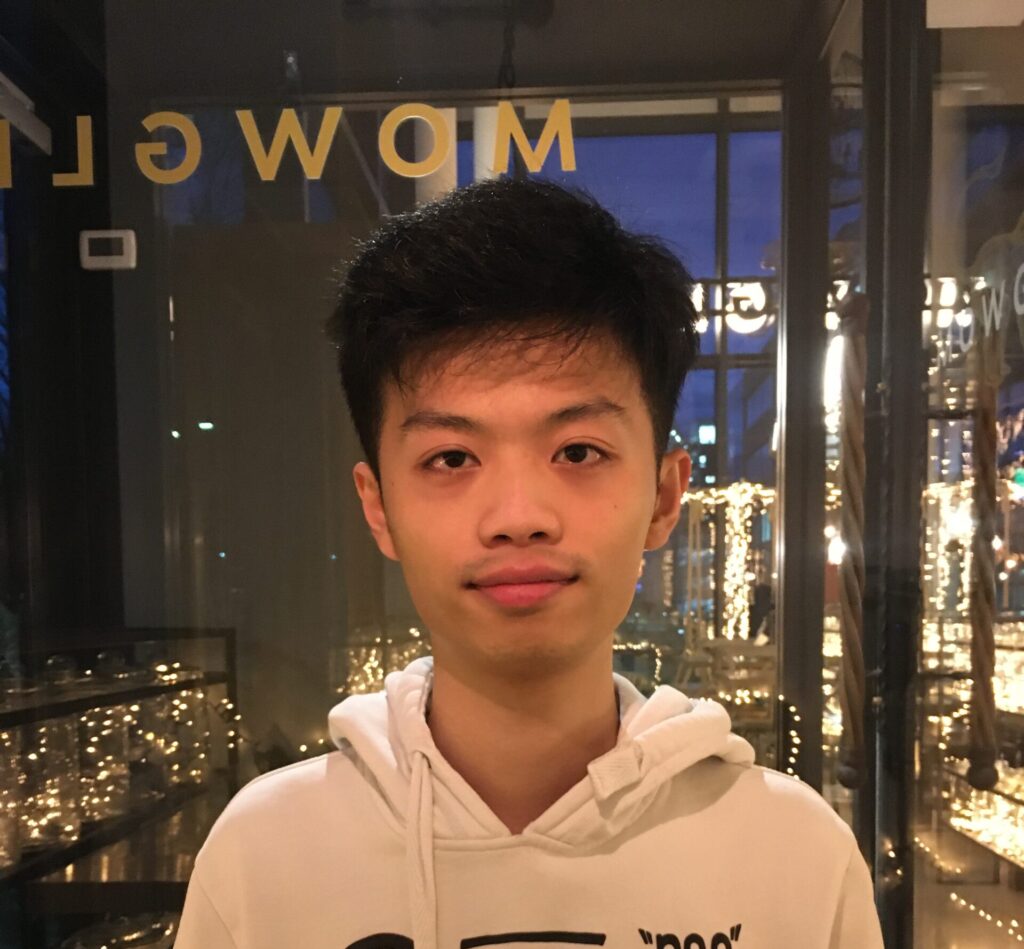
Prof Hongming Tang an astrophysics researcher, science communicator and astro-machine learning educator. He is working as a assistant professor at the department of physics, Xi’an Jiaotong – Liverpool University. His research focus on applying machine learning on hunting rare radio galaxies, identifying radio galaxies of diverse morphologies and investigating under what circumstances one would believe the astro predictions given by machine learning algorithms. He is a member of ASKAP EMU, POSSUM, WALLABY survey collaborations and SKA continuum working group. He is also very keen on astrophysics + machine learning education, aiming to help students know how astronomy/machine learning connects their daily lifes, so as how new technologies faciliate new scientific discoveries.