
The Black Girls in Physics and Astronomy (BGPA) project aims to foster early science identity and STEAM engagement among participants. The project has completed a number of activities for youth leaders and participants, inspiring curiosity and creating a sense of identity and belonging in science spaces.
———–
February 25, 2026: First session hosted by the Eastview Neighbourhood Community Centre. Youth leaders and participants explored telescopes and binoculars, conducted experiments (such as creating slime), and started personal science journals. Each participant received a lab coat, reinforcing a sense of identity and belonging in science spaces. The session concluded with night-sky observations and a discussion of scientific career pathways, highlighting Dr. Maggie Aderin-Pocock as an example to underscore the role of curiosity and inquiry as core scientific competencies.
March 4, 2026: During the second session, BGPA participants had an incredible session filled with discovery, creativity, and connection. They were thrilled to learn about the life cycles of stars with guest speaker and Sister Circle leader Dr. Adaeze Ibik, whose presence brought real-world astronomy to life and helped reconceptualize the hot and cool colours of light. Hands-on activities, led by Dr. Akyea followed. The room lit up as participants created their own “galaxies in a jar,” blending art and science in a hands-on activity that quickly became a favourite. Excitement continued as participants explored photography fundamentals to prepare for capturing the night sky. A standout moment was realizing that, in astronomy, violet light is the hottest and red light is the coolest. The energy, curiosity, and joy in the room showed that these young scientists are just getting started.
March 11, 2026: BGPA’s second Sister Circle was an empowering gathering of science, mentorship, and leadership in action. Participants had the incredible opportunity to connect with Dr. Margaret Ikape, Physics & Astronomy Professor at Bucknell University, who shared her research interests and motivation to study the night sky, led an engaging activity, and inspired participants to see themselves in the future of the sciences. Dr. Akyea facilitated the hands-on learning. Participants conducted a solar power investigation. Together, youth leaders and younger participants designed heat-venting systems and explored how heat energy drives motion. With a pinwheel investigation, they observe how heat causes movement. Bookending the session, youth leaders deepened their own leadership practice through a development workshop led by Dr. Akyea. They completed self-assessments, reflected on their strengths and growth areas, and set SMART goals, grounding their leadership journey in intentional action and continuous reflection.
March 25, 2026: Hosted by curator, Dr. Thelma Akyea and project team member, Dr. Audrey Littlejohn, the Black Girls in Physics and Astronomy White Coat Ceremony was an affirming event, as participants claimed their coats as symbols of belonging, curiosity, and their right to question, explore, and expect meaningful answers. Rooted in both history and possibility, the ceremony celebrated Black girls as scientists and honoured their presence in the field. This ceremony marked the opening pathways for participants’ futures in physics and astronomy. We thank parents, Eastview program coordinator, Laurette Jack, and Eastview director, Mahdi Hussein, for joining in the celebration. In the workshop “Rewrite the Stars,” led by Uda-Lee Hutchinson-McKenzie, participants brought their voices to the forefront through poetry. The workshop was filled with reflection, creativity, and imagination as participants explored their identities and connected them to the vast possibilities of the universe, recognizing that their stories, like the stars, are expansive and full of potential.
April 1, 2026: Dr. Akyea led a session on the Moon. BGPA participants engaged in a rich and thoughtful exploration of the Moon, diving deep into moon phases and uncovering why we only see one side from Earth. The session was filled with curiosity as participants created craters, modelled moon phases, and documented their observations and questions in their lab books. Through diagrams and reflection, they strengthened their ability to explain scientific concepts and track their learning. This session also marked a major milestone for youth leadership. For the first time, youth leaders took the lead in the hands-on activity portion of our session. Working in pairs, youth leaders guided small groups through constellation mapping, moon phase activities, and dramatic demonstrations. They set SMART goals, reflected on their growth, and stepped confidently into facilitation roles. It was a powerful moment of leadership in action, as youth leaders created meaningful learning experiences and began taking ownership of the program’s direction.
April 8, 2026: BGPA participants dove into an exciting exploration of space travel, stepping into the world of Artemis II through an interactive simulation. They unpacked the journey of a spacecraft. Youth leaders brought learning to life with a creative “moon dance,” helping everyone understand why we on Earth only ever see one side of the Moon. Curiosity filled the room as participants asked big, thoughtful questions about space junk, orbiting without fuel, heat shields, and the intense heat of re-entry. Dr. Akyea facilitated a rich conversation about gravity, forces, motion, and energy. Hands-on stations kept the momentum going, with participants rotating through string art, constellation mapping, constellation disks, and constellation cups. The constellation disk activity introduced tool use and design thinking, while string art quickly became a crowd favourite, blending creativity with cosmic learning.
April 15, 2026: BGPA participants experienced an emotive session at Eastview Neighbourhood Community Centre, where science, culture, and wellness came together through rhythm and sound. Led by percussionist and cultural practitioner Sheena “Ajibola” Richardson, the D’jembe drumming session invited participants to explore how vibration and sound shape how we understand the world and the night sky. Through drumming, participants connected ideas of rhythm and energy to how scientists interpret signals from stars and space. Following the session, participants reflected on their learning, shared insights, and continued developing their scientific voice. The energy carried into hands-on work as they advanced their string art, deepened constellation studies, and began selecting their BGPA projects. This session strengthened both scientific understanding and well-being, while reinforcing creative pathways into astronomy.
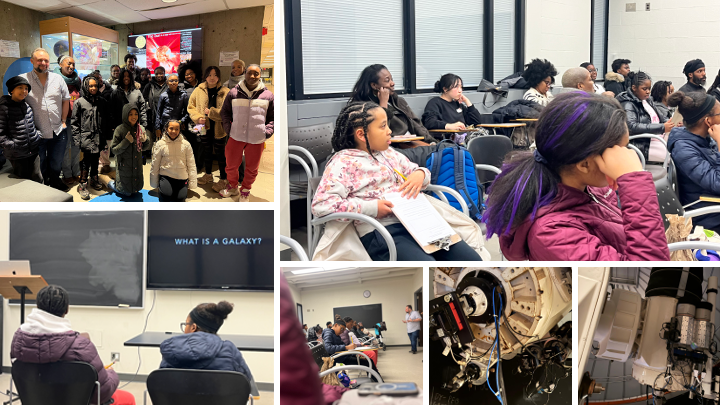
May 2, 2026: BGPA participants experienced an unforgettable day of discovery during their visit to the Dunlap Institute for Astronomy & Astrophysics at the University of Toronto. After a beautiful walk through campus during cherry blossom season, the group stepped into a world of cutting-edge science, where they were warmly welcomed by Dr. Ilana MacDonald, Dr. Renée Hložek, and Dr. Gibwa Musoke. The visit came alive through a roundtable conversation, where each scientist shared their research and passion, sparking deep curiosity. BGPA participants matched their enthusiasm, especially around black holes and dark matter. Participants asked thoughtful questions, connected their prior learning, and engaged as emerging scientists. Hands-on learning continued with a sunspot mapping activity, where participants calculated the Sun’s rotation using real data and explored the technology that allows us to observe the Sun even through cloud cover. The experience included a telescope demonstration and a tour of the institute, offering breathtaking views of the city and a glimpse into the spaces where real astronomy happens. This experience expanded participants’ sense of what is possible in science.
May 6, 2026: BGPA participants welcomed back Dr. Margaret Ikape for an inspiring Sister Circle focused on curiosity, astronomy, and mapping our solar system. Participants officially launched their BGPA projects by selecting topics and mapping them to research questions. We used the BGPA project planning workbooks to guide thinking. Excitement was high as participants stepped further into their roles as researchers and scientists.
May 13, 2026: BGPA participants welcomed Medical Physicist Dr. Nadia Octave, who flew in from Quebec, for an engaging Sister Circle focused on medical physics, leadership, and healthcare innovation. Dr. Octave shared her journey into the field, her passion for radiation oncology, and her leadership in helping design safe hospital facilities and treatment spaces. Participants explored radiation through hands-on activities and examined models of medical devices used in patient care. Following her presentation, Dr. Octave worked alongside participants as they continued developing their BGPA research projects and experiments.
May 20, 2026: Black Girls in Physics & Astronomy continues to build momentum as participants move toward the June 5 showcase. Last week, BGPA completed its 5th Sister Circle with Dr. Estelle Inack from the Perimeter Institute, who inspired participants through stories of theoretical physics, entrepreneurship, innovation, and resilience. Alongside physics exploration and project development, youth leaders are continuing their leadership training by mentoring younger participants, supporting experiments, documenting findings, and helping prepare final display boards. Participants are now in the final stages of completing investigations they designed, developed, and carried out themselves.