
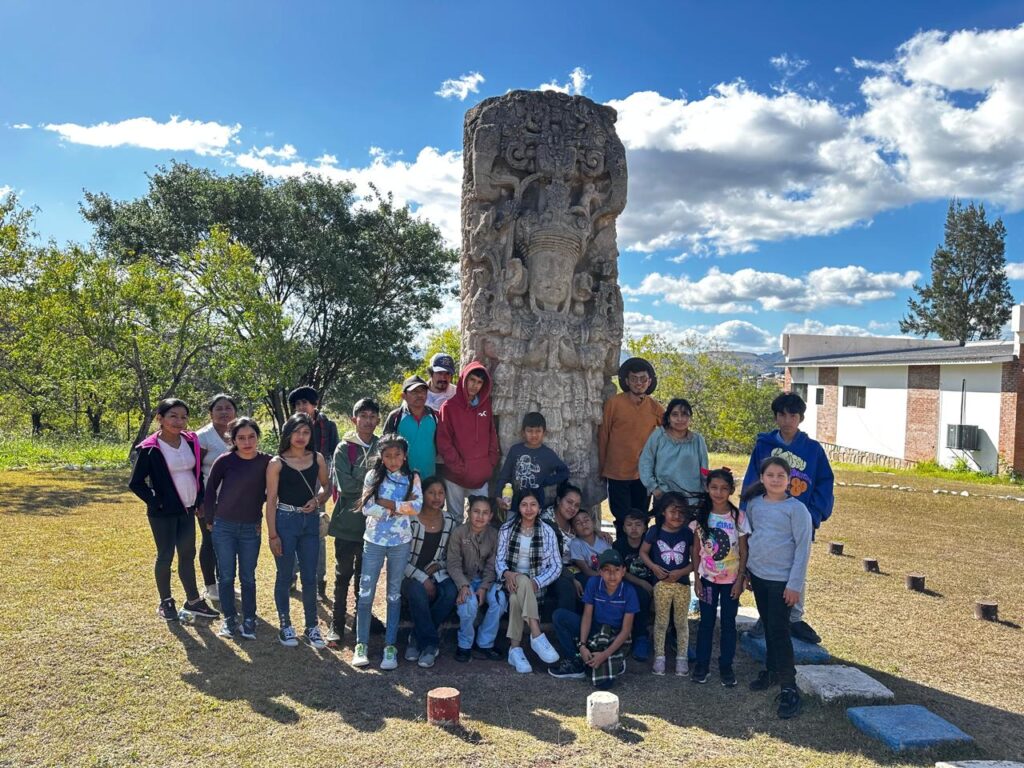
The project established a community educational program in the remote community of El Rincón in Honduras. Residents of El Rincón live in conditions of extreme poverty with little access to education. Nearly all families work on coffee fields, including children, who are expected to help their families from an early age. The project consisted of astronomy and science workshops delivered to the community in person and online, as well as an excursion to the Astronomical Observatory at the National Autonomous University of Honduras (UNAH) in the capital Tegucigalpa. We provided a meal to participants on each occasion. Alongside these activities, we supported the community with tech & infrastructure (including laptops, a projector, contribution to Wi-Fi connectivity, electricity expenses and stationery)
The team worked with a series of partners to secure ongoing support to the educational needs of the community:
– Alpha-Cen a non-profit and non-governmental scientific organisation created for the development and strengthening of research in astronomical sciences in Central America and the Caribbean.
– COMSA, a coffee farming cooperative based in Marcala (the municipality where El Rincón is located).
– Social architecture collective Arqtuar: a Honduran non-profit organisation created to share with people in need techniques that could help them to improve their daily activities at home.
Deliverables
– 4 in-person visits from scientists, engineers and architects to the community of El Rincón. Topics: 1) Chemistry of the soil, modern agricultural practices; 2) Mayan and cultural astronomy; 3) Ecotechnologies: Rainwater collection system and homemade paint preparation; 4) Ecotechnologies: greywater filter, vertical gardens, and compost.
– 6 online talks delivered by astronomers and a mathematician. Topics: 1) Sun & solar layers; 2) The Scientific Method & Galaxies; 3) Black Holes; 4) Discovering Mathematics!; 5) Lifecycle of Stars: A Dance between Creation and Destruction; 6) Programming Principles.
– 10 study circles: open discussions and reflections in the community on the activities / talks organised in the previous weeks.
– Excursion to the astronomical observatory at the Autonomous University of Honduras (UNAH) in the capital Tegucigalpa.
– Alongside the activities above, we supported the community with tech & infrastructure (including laptops, a projector, contribution to Wi-Fi connectivity, electricity expenses and stationery, etc.)
Outcomes
– Two girls who were discouraged about attending school later joined classes
– Improved grades in math for at least 3 children
– Increased motivation amongst children to participate in educational programs
– Greater understanding or interest in science, technology, and math amongst parents or adult participants
– Provided members of the community with access to new educational content and experiences otherwise not accessible
– Established support from local entities (businesses, institutions).
– Established an engagement model that can be replicated in other communities
Feedback
Audience: The community is very happy about the knowledge and support we’ve received. The adults say they wish they had had these opportunities as children, and they encourage the kids to value them since they do have them. We’ve seen how people began independently looking up topics related to what was taught in the workshops. The children talk about some of the things they learned in the workshops during their playtime. So, this program had a tremendously positive impact on all participants.
Speaker: At the end we also made a little diagnosis to find out what other problems face the community and that could be treated with some more eco techniques, for future talks that we could give to them. Claudia was really excited because the people seem to be interested in learning this kind of stuff and this is the main reason why we created the organization, just to share with people in need techniques that could help them to improve their daily activities at home. So, if you let us, we will prepare more talks about it to help them as much as we can.
Activities
FEBRUARY
Saturday 17/02/2024 – Official start of the project, 1st in person visit – DONE.
Speaker: Pamela Oliva (Local facilitator)
Topic: Chemistry of the soil, modern agricultural practices
Duration: half a day, including lunch with the community
MARCH
Saturday 02/03/2024 – 1st study circle
Facilitator: Oved Lopez
Topic: open discussion around previous activity / talk + feedback for the project + questions for the speakers / organisers. First survey of participants to the project particularly focussed on Outcomes / Measures 2 and 4
Duration: 1 hour
Saturday 16/03/2024 – 1st online lecture.
Speaker: Diana López (Alpha-Cen member)
Topic: Sun & solar layers
Hands-on activity: model solar layers with clay
Duration: 1 hour + discussion and snacks afterwards
Saturday 30/03/2024 – 2nd study circle – DONE.
Facilitator: Oved Lopez
Topic: open discussion around previous activity / talk + feedback for the project + questions for the speakers / organisers
Duration: 1 hour
APRIL
Saturday 27/04/2024 – 2nd online lecture
Speaker: Skarleth Motiño (Alpha-Cen Vice President)
Topic: The Scientific Method & Galaxies
Duration: 1 hour + discussion and snacks afterwards
MAY
Saturday 11/05/2024 – 3rd study circle
Facilitator: Oved Lopez
Topic: open discussion around previous activity / talk + feedback for the project + questions for the speakers / organisers
Duration: 1 hour
Saturday 25/05/2024 – 2nd in person visit
Speaker: Eduardo Rodas-Quito (Alpha-Cen member, part of the Exec Committee)
Topic: Mayan and cultural astronomy
Duration: half a day, including lunch with the community
JUNE
Sunday 09/06/2024 – 4th study circle
Facilitator: Oved Lopez
Topic: open discussion around previous activity / talk + feedback for the project + questions for the speakers / organisers
Duration: 1 hour
Saturday 29/06/2024 – 3rd online lecture
Speaker: Rodrigo Sacahui (Alpha-Cen President)
Topic: Black holes
Duration: 1 hour + discussion and snacks afterwards
An activity was organised: a black cloth was held by all kids and different objects were placed at its centre to mimic the curvature of space-time caused by massive objects.
JULY
Sunday 14/07/2024 – 5th study circle
Facilitator: Oved Lopez
Topic: open discussion around previous activity / talk + feedback for the project + questions for the speakers / organisers
Duration: 1 hour
Saturday 20/07/2024 – 3rd in person visit
Speakers: Architects Joel Oliva & Claudia Bueso from the non-governmental organisation “Colectivo de arquitectura social Arqtuar”.
Topic: “Ecotecnias: Sistema de recolección de aguas lluvias y preparación de pintura casera” (sustainability at home: “Ecotechnologies: Rainwater collection system and homemade paint preparation”)
Partner: Colectivo de arquitectura social Arqtuar (Social architecture collective Arqtuar).
Duration: half a day, including lunch with the community
AUGUST
Sunday 04/08/2024 – 6th study circle – DONE.
Facilitator: Oved Lopez
Topic: open discussion around previous activity / talk + feedback for the project + questions for the speakers / organisers
Duration: 1 hour
Saturday 24/08/2024 – 4th online lecture
Speaker: Carlos Osorio Anderson (PhD candidate in Mathematics at the Universidad Autónoma de San Luis Potosí, Mexico; originally from Marcala, Honduras)
Topic: Discovering Mathematics!
Duration: 1 hour + discussion and snacks afterwards
Resources: Virtual Museum of Mathematics (UNAM), https://mumat.matcuer.unam.mx/
Saturday 31/08/2024 – 7th study circle
Facilitator: Oved Lopez
Topic: open discussion around previous activity / talk + feedback for the project + questions for the speakers / organisers
Duration: 1 hour
SEPTEMBER
Saturday 21/09/2024 – 5th online lecture
Speaker: Fabián Quesada Zúñiga (Alpha-Cen)
Topic: Ciclo de vida de las Estrellas: Un Baile entre la Creación y Destrucción (Lifecycle of Stars: A Dance between Creation and Destruction)
Duration: 1 hour + discussion and snacks afterwards
OCTOBER
Wednesday 02/10/2024 – 8th study circle
Facilitator: Oved Lopez
Topic: open discussion around previous activity / talk + feedback for the project + questions for the speakers / organisers
Duration: 1 hour
NOVEMBER
Sunday 10/11/2024 – 4th in person visit
Speakers: Architects Joel Oliva & Fernando Amaya from the non-governmental organisation “Colectivo de arquitectura social Arqtuar”.
Topic: “Ecotecnias: Filtro de aguas grises, huertos verticales y composta” (sustainability at home: “Ecotechnologies: greywater filter, vertical gardens, and compost”)
Partner: Colectivo de arquitectura social Arqtuar (Social architecture collective Arqtuar).
Saturday 23/11/2024 – 9th study circle
Facilitator: Oved Lopez
Topic: open discussion around previous activity / talk + feedback for the project + questions for the speakers / organisers
Duration: 1 hour
Saturday 30/11/2024 – 6th online lecture
Speaker: Paola Oliva Altamirano (Alpha-Cen)
Topic: Principios de Programación (Programming Principles)
Duration: 1 hour + discussion and snacks afterwards
Resources: http://codespark.com
DECEMBER
Saturday 14/12/2024 – 10th study circle
Facilitator: Oved Lopez
Topic: open discussion around previous activity / talk + feedback for the project + questions for the speakers / organisers
Duration: 1 hour
FEBRUARY 2025
Thursday 06/02/2025 – Excursion to the Astronomical Observatory at the Universidad Nacional Autónoma de Honduras (UNAH) in Tegucigalpa
Hosts at UNAH: Javier Mejuto (Alpha-Cen member and Dean of the Faculty of Space Sciences of the UNAH), Eduardo Rodas-Quito (Alpha-Cen member, part of the Exec Committee), María Quiroz.
Topic: Cultural astronomy and astronomical observations, science for development, applications of astronomy
The visit was a success: 29 people from the community (22 children and teenagers + 7 adults) participated. They left the community at 5 am and arrived in Tegucigalpa at 10 am. For some of the participants it was the first time in the capital. At the end of the visit, we did a video call and many people wanted to say thank you to the organisers for the opportunity. All stressed that they learned a lot and they would like to keep learning.
MAY 2025
Saturday 10/05/2025 – Post Program Final Survey
Final survey and debrief with the community. Formal conclusion of the project.