

This blog post was written by Dr. Facundo Rodríguez, project lead of the IAU OAD funded Right to Sky project in Argentina
Originally published at https://diciembre.org/ciencia-y-memoria-ana-teresa-diego-el-cielo-tambien-recuerda/
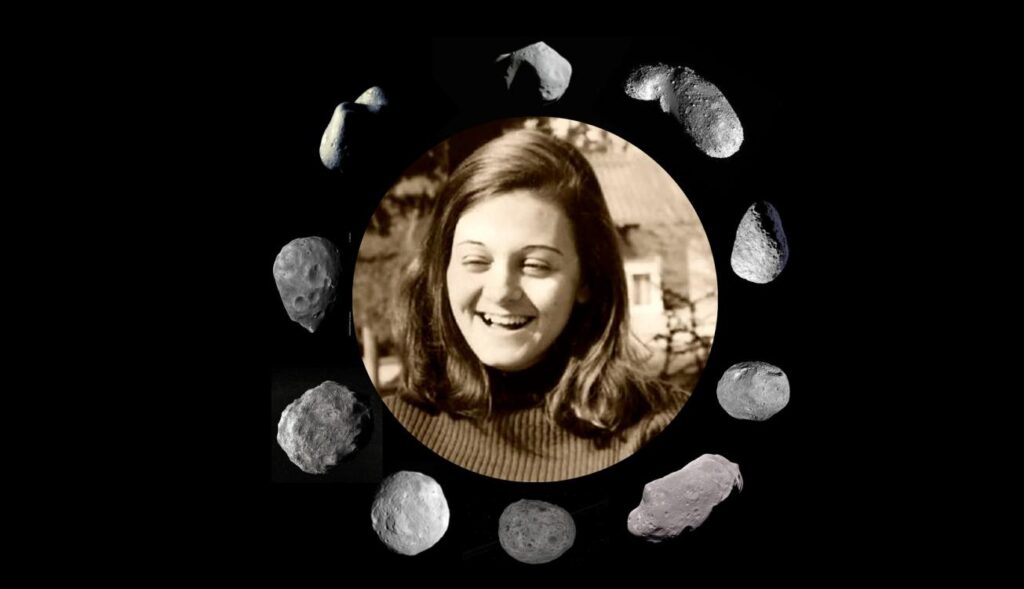
The sky, its interpretation and what is said about it tells us a lot about the people who observe it. And, even from a scientific perspective, it changes depending on who is looking at it. An example is that a star bears the name of Ana Teresa Diego, an astronomy student who disappeared during the last civil-military-church dictatorship in Argentina.
On 31 December 1975, just before the beginning of one of the worst years in Argentinean history, Mario Reynaldo Cesco was studying the sky from what is now the observatory of “El Leoncito” in San Juan. During that night of observation, he detected an asteroid that had not yet been catalogued (one of the six he discovered during his career).
As with all asteroids, the institution in charge of collecting observations of asteroids and comets, the Minor Planet Centre (MPC), gave it the provisional name 1975 YD. This name comprises a number, the year, and two letters: the first indicates the fortnight in which the sighting occurred and the second the order of discovery within the fortnight (D indicates that it was the fourth observed in that period).
At the same time, Ana Teresa Diego was 21 years old and was studying for a degree in astronomy at the National University of La Plata. She lived in Bahía Blanca until she moved to La Plata to start her studies at the Faculty of Astronomical and Geophysical Sciences. A few months earlier, she had lost her father, Antonio Diego, a very committed mathematician and teacher at the Universidad Nacional del Sur, but she still had the support of her mother, Zaida Franz.
Shortly after starting her university career, Ana joined the Communist Youth Federation, which did not come as a surprise to her family, as the political tensions of the time crisscrossed their home. In her family, in her militancy and her studies, she would be remembered for her joy and her commitment.
On 30 September 1976, at midday, Ana was leaving the university when four armed men intercepted and kidnapped her. These repressors put her in a car without a number plate. In addition, the flat she was renting was vandalised and emptied.
After her disappearance, students repudiated the terrorist action, and her mother started to look for her. Zaida Franz, true to her commitment, networking with others who were looking for relatives who had disappeared during the dictatorship. Her tireless work led her to participate in the first meetings of relatives of the disappeared in Bahía Blanca, in the first marches of the Mothers of La Plata, and to become a founding member of the Mothers of Plaza de Mayo.
Different investigations and testimonies helped to reconstruct what happened to Ana. It was determined that she was taken to the clandestine detention centre located in the Infantry Corps of the Police of the Province of Buenos Aires, then she was transferred to the “Destacamento de Arana”, and, at the beginning of October, to the “Pozo de Quilmes”.
For 35 years, Ana’s remains were not found. Her mother, relatives, friends and human rights activists continued to search for them.
At the same time, the asteroid discovered by Cesco had been analysed. This body is part of the asteroid belt and therefore revolves around the Sun together with a huge multitude and diversity of astronomical objects. Its orbit could be accurately described and its future trajectory could therefore be predicted. When this happens, it is assigned a number and a name that must be approved by the International Astronomical Union (IAU, the international decision-making body in the field of definitions and standards in astronomy).
Given these conditions, in 2011, at the request of the then Dean of the Faculty of Astronomical and Geophysical Sciences at the University of La Plata, Adrián Brunini, the asteroid 1975 YD (now numbered 11441) was renamed “AnaDiego”, in honour of this missing student.
There are many asteroids with very varied names, but this was the first time that the name of a person disappeared by one of the dictatorships of the Southern Cone was assigned to a body in the Solar System.
Ana had reached the sky and her memory was more alive than ever when, in May 2012, after so many years of searching, the Argentine Forensic Anthropology Team (EAAF) identified her remains. They had been buried in the second half of 1976 as NN in a mass grave in the Avellaneda cemetery. Her case was tried in the case called “Camps” in 1986, “Circuito Camps”, with a sentence in December 2012, and she is currently being included in other cases of crimes against humanity in the city of La Plata.
We will never know how she would have continued her life, her professional career and her militancy. However, the asteroid AnaDiego will be there to remind us of this story and that of all the people who disappeared by the last Argentinean civil-military dictatorship. Somehow, Ana Teresa Diego took the NUNCA MÁS (NEVER AGAIN) beyond our planet.