
By Dr Joyful Mdhluli, OAD Flagship Coordinator
The International Day of Women and Girls in Science was proclaimed by the United Nations General Assembly in 2015 to recognise the critical role women and girls play in science and technology. Celebrated annually on February 11, it aims to promote full and equal access to participation in science for women and girls, addressing persistent gender gaps in STEM (Science, Technology, Engineering, and Mathematics) fields. Globally, women make up less than 30% of researchers, and this underrepresentation limits innovation and progress. The day features events, workshops, and campaigns organised by bodies like UNESCO and UN Women, often under themes that emphasise leadership, equity, and inclusion. For instance, the 2026 theme focuses on synergising AI, social sciences, and STEM to build inclusive futures, underscoring the need for diverse voices in tackling global challenges like climate change and health crises.
This day isn’t just about equality – it’s deeply intertwined with the concept of “science for development,” where scientific advancement drives sustainable socio-economic growth, poverty reduction, and the achievement of the UN’s Sustainable Development Goals (SDGs). By empowering women and girls in science, we enhance innovation’s impact on issues like food security, renewable energy, and education (SDGs 2, 7, and 4). Gender-inclusive science leads to more holistic solutions, as diverse perspectives foster creativity and address biases in research. For example, increasing women’s involvement in STEM strengthens national development strategies, particularly in developing regions where astronomy and space sciences can inspire education and skills-building. The UN positions this day as a key accelerator for SDG 5 (Gender Equality) and SDG 9 (Industry, Innovation, and Infrastructure), making science a tool for equitable, inclusive progress worldwide.
The International Astronomical Union’s Office of Astronomy for Development (IAU OAD) plays a pivotal role in this intersection by leveraging astronomy as an accessible, inspiring entry point to STEM. Through the annual call for proposals, the OAD funds global projects that align with SDGs, including gender equality – one of the thematic areas at the OAD. Over the years, the OAD has supported initiatives that empower underrepresented groups, particularly women and girls, in science. The OAD’s work ties directly to the International Day of Women and Girls in Science by promoting inclusive astronomy education, which builds skills, confidence, and leadership. Our regional offices amplify this by addressing local barriers, such as in rural or underserved communities. Overall, the OAD demonstrates how astronomy – a field that sparks wonder – can drive development by closing gender gaps and fostering diverse scientific communities.
Here are some standout OAD-supported projects that embody these goals. These initiatives use astronomy to inspire STEM participation, often aligning with the spirit of February 11 by highlighting women’s contributions and creating pathways for girls.
- SciGirls – Empowering Girls in Science Through Astronomy (Ethiopia): This project runs workshops for secondary school girls and female teachers in rural and conflict-affected areas, using astronomy’s hands-on appeal to build STEM interest and advocacy skills. It has trained hundreds, reducing dropout rates and positioning participants as future leaders in science for Ethiopia’s development.
- Elimisha Msichana Elimisha Jamii na Astronomia (Educate a Girl, Educate the Entire Community with Astronomy) (Kenya and Uganda): Funded in 2024 and 2025, this program educates girls in astronomy, extending knowledge to families and communities to combat high dropout rates. It promotes gender equality in education, fostering community-wide sustainable development through STEM empowerment.
- Astro Molo Mhlaba (South Africa): Targeting Black girls from underserved communities, this long-term program inspires passion for astronomy and STEM careers. It won the IAU Women & Girls in Astronomy Prize and was shortlisted for Nature Research Awards, emphasising inclusivity and tools for overcoming barriers in South African contexts.
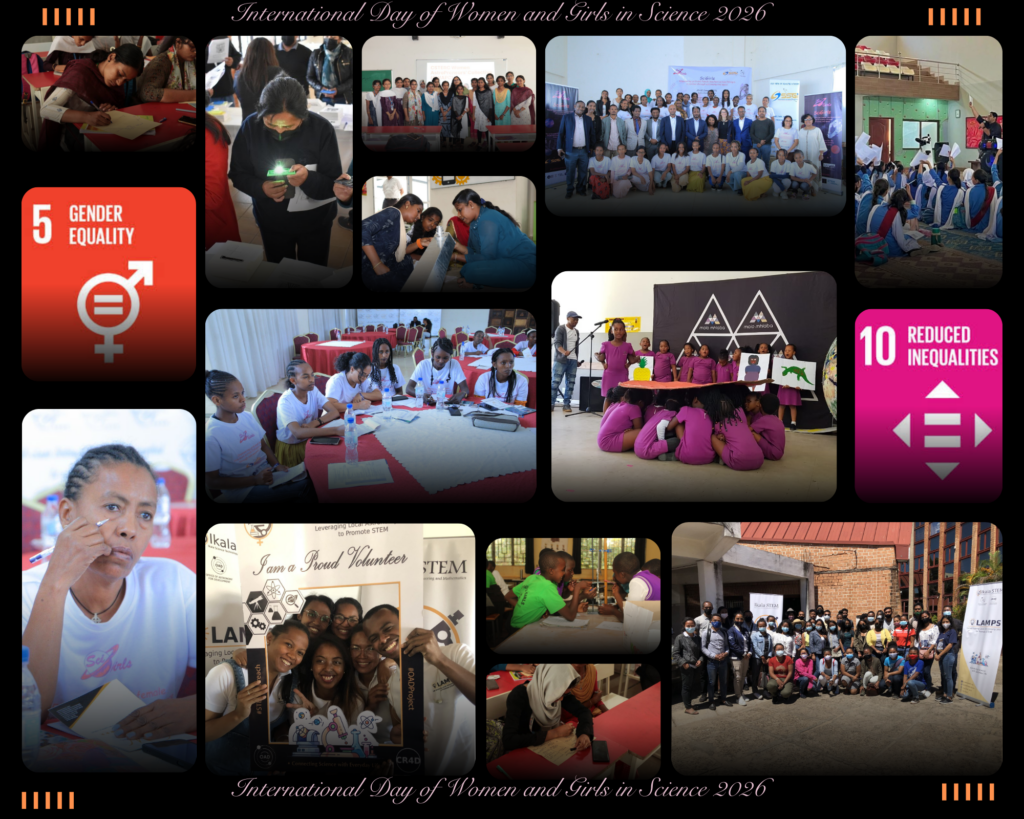
- LAMPS (Leveraging Local Astronomy Site to Promote STEM in Madagascar) (Madagascar): Led by Ikala STEM, it encourages girls and young women in astronomy outreach, shortlisted for awards and linking to broader development by building local scientific capacity.
- Black Girls in Physics and Astronomy (Canada, with global echoes): Supported in 2026, it builds confidence and leadership among Black girls in physics and astronomy through culturally affirming activities, addressing underrepresentation and tying to SDG 5.
- CSTERC Women AstroPreneurs’ Collective (India): From 2025 funding, it fosters women’s entrepreneurship in astronomy, blending STEM skills with economic empowerment for gender-inclusive growth.
- Inspiring STEM Engagement through the Support of Astronomy Programs in Primary School in Kisumu County (Kenya): A 2026 project inspiring primary school girls in STEM via astronomy, supporting educational development goals.
- Women and Girls Astronomy Program (WGAP) (North America via North American Regional Office of Astronomy for Development (NA-ROAD)): This mini-grant program funds annual projects to empower women, girls, and underrepresented genders in astronomy, challenging barriers and promoting diverse development-focused initiatives.
These projects showcase the OAD’s commitment to using astronomy for transformative impact. This day reminds us that inclusive science isn’t optional; it’s essential for a developed, equitable world.